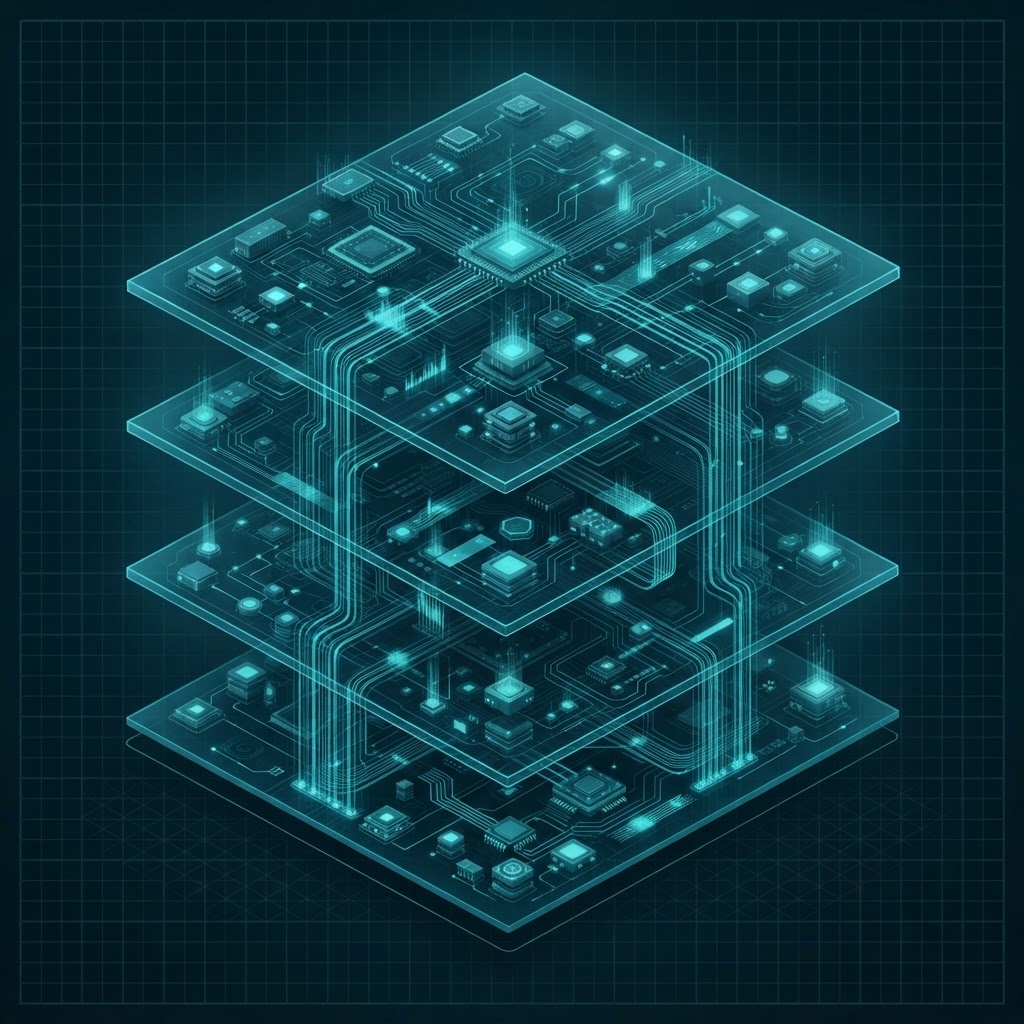
The Four-Layer Business Architecture
Process, information, control and operating. Four connected layers that turn a set of improvements into an operating business, and the one place a platform decision is allowed to be made.
Summarised from the Go2Cab business insight series
One baseline ledger, four layers
A set of improvements is not yet an operating business. What turns one into the other is architecture: a small number of layers that each own something specific, connected so that a gain in one is not quietly lost in the next.
The rule holding the four together is simple. No layer may contradict the measured baseline of the layer before it, and every claim in a later layer has to trace back to a number produced earlier. That single ledger is why the architecture survives contact with an audit, a board review or a bad quarter.
Layer 1 — Process architecture
Which value streams should exist, what each one owns, and how work actually flows between them — with variation and handoffs designed out rather than automated exactly as they are.
- Deliverable: future-state value stream design, standard work and process ownership.
- Proof it is real: a quantified baseline of cycle time, throughput, defect rate and process capability.
- Platform touchpoint: none required. This layer runs on the systems you already own.
Layer 2 — Information architecture
The data model the redesigned process genuinely needs, defined before any module is configured. This is also the foundation every forecast, anomaly model and Copilot* answer depends on: clean, modelled, trustworthy data.
It is the only place a platform decision is made, and it is made on evidence.
- Deliverable: master data, cost objects, transaction truth and inventory signals.
- Proof it is real: a justified decision — Dynamics 365*, Business Central, or nothing at all.
- Platform touchpoint: the decision point. Dynamics 365 or Business Central enters here, if it earns the place.
Layer 3 — Control architecture
Where the business steers from. Every critical process gets a control point, a limit, a predictive alert and a defined response, so performance is managed by exception and drift is flagged by analytics before it becomes a loss.
- Deliverable: SPC control points, predictive alert thresholds, financial close calendar, JIT replenishment triggers, a KPI tree.
- Proof it is real: control limits and predictive alerts that are live and owned, not a dashboard.
- Platform touchpoint: D365 Process Advisor, Power BI and predictive alerting wired to the same control points.
Layer 4 — Operating architecture
The roles, cadence and change control that hold the gains after the engagement ends. Architecture that is not operated reverts to the old process within a couple of quarters, which is the most common way a good redesign is lost.
- Deliverable: operating cadence, role design, capability plan and change control.
- Proof it is real: adoption measured in behaviour and decision speed, not training attendance.
- Platform touchpoint: Power Automate and Copilot agents carry the cadence, escalation and review rhythm.
The same architecture, commissioned two ways
Track A and track B are not two products. They are this architecture at two depths — the process layers alone, or all four with the result built into the platform.
| Layer | Track A — process | Track B — platform |
|---|---|---|
| 01 Process | Delivered | Delivered |
| 02 Information | Documented only | Delivered |
| 03 Control | Delivered | Delivered |
| 04 Operating | Delivered | Delivered |
01 Process
Track A — process
Delivered
Track B — platform
Delivered
02 Information
Track A — process
Documented only
Track B — platform
Delivered
03 Control
Track A — process
Delivered
Track B — platform
Delivered
04 Operating
Track A — process
Delivered
Track B — platform
Delivered
What this prevents
- A platform chosen before the process was understood, then defended afterwards.
- Analytics built on data nobody has modelled, producing confident answers to the wrong question.
- Controls that exist as dashboards but never as a defined response to a limit being breached.
- A redesign that holds for one quarter because no role, cadence or change control was ever designed for it.
Where the layers come from
The layers are not a framework imposed at the start. They are where the outputs of the six pre-ERP phases land: immersion and value stream mapping feed layer one, the measured baseline feeds layer two, root-cause design and control plans feed layer three, and the operating model feeds layer four. The phases are set out in full in The Six Phases Before We Configure Anything.
You can commission the process layers on their own and never touch your platform. You can commission all four and have the result built into Dynamics 365. Either way the output is an intelligently architected business, not a system that mirrors the one you already had.
*All product names, logos, brands, and AI models mentioned in this article are the property of their respective owners and are used for identification purposes only, without implying endorsement or affiliation with Go2Cab.
The takeaway
Four layers, one baseline ledger: process, information, control, operating. Decide the platform inside layer two, on evidence, or it will be decided for you by a template.